
Loading...
Loading...
Dec 2013 — Ongoing
Project Background:
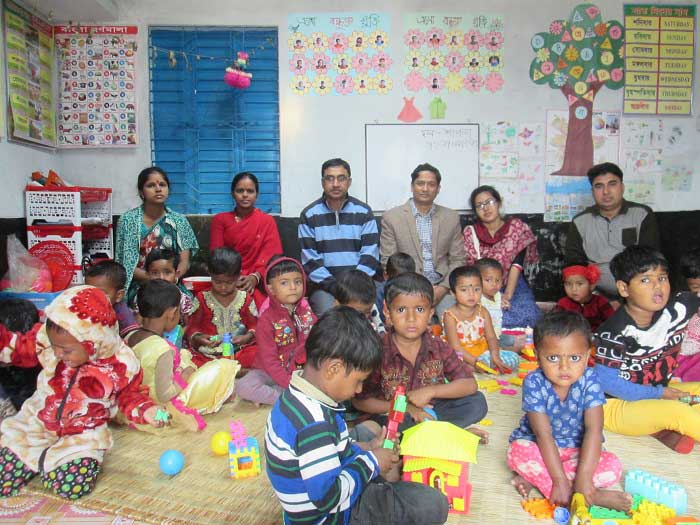
Access to quality pre‑primary education remains very limited in rural Bangladesh, particularly for children aged 3–5 from poorer households. This project designed and evaluated two early childhood programs in remote villages—an intensive village‑based preschool and a structured home‑visiting program—to understand their impacts on children’s cognitive and non‑cognitive development and the role of parental social networks. Drawing on international models such as Perry Preschool and the Chicago Heights Early Childhood Center (CHECC), the interventions aimed to build foundational literacy, numeracy, executive function and socio‑emotional skills so that children are ready for primary school.
Over two years (2017–2019), the study implemented a cluster randomized controlled trial with about 7,000 children aged 3–5 in 222 villages in Khulna and Satkhira districts. Villages were randomly assigned to: (i) a 5‑day‑per‑week preschool program; (ii) a weekly home‑visit parenting program with varying saturation; (iii) a combined 3‑day preschool plus home‑visit package; or (iv) a control group with no early childhood program. Children were assessed at baseline, after one year, and after two years using adapted Woodcock–Johnson literacy and numeracy tests and executive‑function tasks, complemented by the Ages and Stages Questionnaire (ASQ‑3) and detailed household and parenting surveys. All three treatments produced large and similar gains of around 0.5 standard deviations in both cognitive and non‑cognitive skills, with the largest improvements among initially weaker and poorer children and clear spillovers to untreated siblings and village peers.
A core innovation is the explicit measurement of parental social networks and their role in mediating spillovers from the home‑visit program. The study finds that untreated children in home‑visit villages also experienced significant improvements (about 0.2 standard deviations), and that these gains were larger when their parents were socially connected to treated families who had received intensive parenting support. This shows that strengthened parenting practices can diffuse through informal village networks, amplifying program impact beyond directly treated households.
Project Areas:
222 remote rural villages in Khulna and Satkhira districts, southwest Bangladesh, without formal preschool services at baseline.
Approximately 7,000 children aged 36–60 months at enrolment and their families, plus siblings and cousins living in the same households.
Project Authority:
Lead Academic Institutions: Monash University (Australia); University of Chicago (USA); University of Southampton (UK).
Research Partners: IZA; CEPR.
Local Implementation Partner: Global Development Research Initiative (GDRI), Bangladesh.
Donors:
ESRC–DFID/FCDO joint funding programme (grant ES/N010221/1).
Roles of GDRI:
Program Design and Local Adaptation:
Collaborated with Monash University, BRAC Institute of Education and Development (BIED) and Dhaka University’s Institute of Education and Research (IER) to adapt an integrated early childhood curriculum and home‑visiting toolkit for rural Bangladesh.
Identified suitable village locations, secured community spaces for preschools, and ensured compliance with local safety and child‑protection norms.
Field Implementation and Training:
Recruited and managed local female teachers from participating villages, all with at least secondary education and prior tutoring/teaching experience.
Organized an initial 5‑day intensive training and monthly refresher trainings for preschool and home‑visit teachers on child‑centred pedagogy, curriculum delivery, caregiver engagement, and assessment protocols.
Oversaw daily operation of 5‑day‑per‑week preschool centres and scheduling of weekly home visits and parent group meetings in treatment villages.
Data Collection and Monitoring:
Conducted baseline, midline and endline child assessments (literacy, numeracy, executive function), household surveys and parental practices modules using trained graduate enumerators.
Implemented a dedicated parental social‑network survey before the intervention to map connections between households (borrowing, support during illness, visiting).
Monitored attendance, program fidelity and teacher performance through regular field supervision and coordination with village leaders.
Research Support and Dissemination:
Managed field logistics, data entry and cleaning to produce the child and parent‑level analytic datasets.
Supported interpretation and communication of findings to Bangladeshi stakeholders, highlighting that low‑cost preschool and structured home‑visits can deliver large gains and that leveraging parental networks can magnify benefits for non‑treated families.
Project Type
Completed Projects
Duration
Dec 2013 — Ongoing
Focus Themes
Addressing Learning Loss Using Low Tech Remote Learning among Underprivileged High School Students: The Bangladesh Case
Ongoing Projects
Mar 2023
Income Loss and Wellbeing during COVID-19 Lockdown in Rural Bangladesh: Evidence from Large Household Surveys
Completed Projects
Apr 2023
Telementoring and Homeschooling during school closures: A randomized Experiment in Rural Bangladesh
Completed Projects
Mar 2021